


“To know everything is to know nothing, but to know something about everything is to have some idea of what everything is about.”—Unknown
LEONARDO DA VINCI
Leonardo da Vinci was my childhood inspiration. I aspired to be like him. The more I researched him, the more I was in awe of his mind. His ideas were so ahead of his time that conspiracy theorists believe he’s a time traveler.
You may know him for painting the Mona Lisa and The Last Supper, some of the world’s most famous art, but he’s more than an artist. Leonardo da Vinci is the quintessential Renaissance Man. The term “Renaissance Man” originated during the Renaissance period in Europe when scholars, artists, and thinkers explored a range of disciplines. The term became popular because Leonardo excelled in painting, sculpture, mathematics, engineering, anatomy, music, and more. He was a rare breed of creative genius. Most creators are either intellectually deep in one topic or shallow in many topics. Leonardo da Vinci went deep into many topics.
As an artist, he pioneered oil painting. He was the first artist to use perspective, chiaroscuro, contrapposto, sfumato, and many other painting techniques. He didn’t only create art. He elevated it.
In the realm of engineering, Leonardo da Vinci was a visionary. He drafted plans for a diverse range of inventions, including a helicopter, a parachute, folding furniture, automated musical instruments, a water-powered alarm clock, the bicycle, an extendable ladder, an armored tank, a machine gun, a guided missile, a submarine, and many more. But his most significant contribution to engineering wasn’t any of his inventions. It was his concept of automation. He saw the potential for machines to alleviate human labor and enhance productivity long before the Industrial Revolution.
Da Vinci was also a trailblazer in anatomy and botany. He dissected human bodies and made detailed drawings, pioneering modern comparative anatomy. In botany, he was the first to note the relationship between a tree’s age and the number of rings in its trunk.
And here’s the thing: all of these achievements happened in the 1400s. Leonardo da Vinci’s curious mind noted observations that predated many discoveries by Copernicus, Galileo, Newton, and Darwin.
40 years before Copernicus proposed that the Sun is the center of the solar system and that the planets circle the Sun, Da Vinci noted, “The sun does not move…The earth is not in the center of the circle of the sun, nor in the center of the universe.”
60 years before Galileo, he suggested that “a large magnifying lens” should be employed to study space.
200 years before Newton’s theory of gravitation, Leonardo wrote, “Every weight tends to fall towards the center by the shortest possible way…every heavy substance presses downward, and cannot be upheld perpetually, the whole earth must become spherical.”
400 years before Darwin, da Vinci noted that man does not vary from animals except in what is accidental. He also observed geotropism, the gravitational attraction of the earth on some plants, and heliotropism, the attraction of plants toward the sun.
These are all just a few of his contributions to humanity. Leonardo da Vinci’s ideas shaped the world we live in. He was ahead of his time and deserved the title Renaissance Man.
INCREASING YOUR CHANCES OF WINNING A NOBEL PEACE PRIZE
In 2008, a team of researchers conducted a study on how creativity influences other fields. They compared Nobel Prize-winning scientists from 1901 to 2005 with other expert scientists of their time. They found that Nobel Prize scientists were more likely to have a hobby in the arts than their less accomplished colleagues. The table below summarizes this correlation:
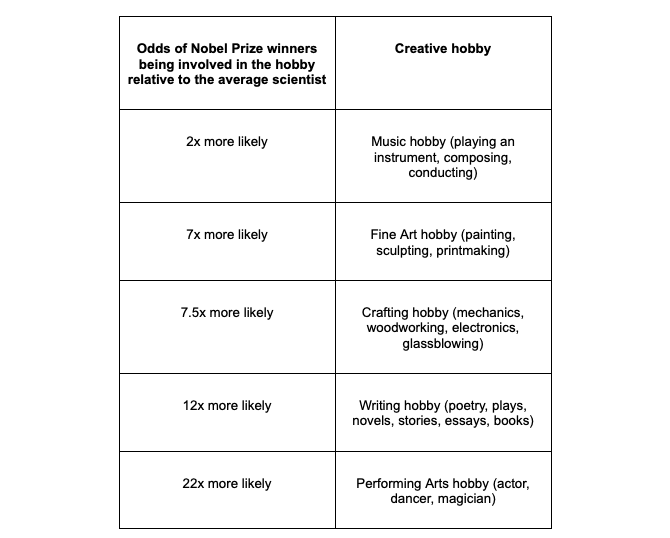
Yes, you read that correctly. Nobel Prize winners were 2x more likely to have a music hobby than the average scientist. 7x more likely to have a Fine Art or Crafting hobby, 12x more likely to have a writing hobby, and a whopping 22x more likely to have a performing arts hobby like acting, dancing, or even being a magician.
This is not limited to science. Creativity researchers often see this phenomenon when observing how people succeed in multiple areas. This is one of the core benefits of creativity. It’s an unfair advantage you can apply in every aspect of your life. Once mastered, it’s like carrying a gun to a knife fight in another field.
THE BLEND
Science and art are two ends on the spectrum of creativity. When we engage in science, we use our creativity to gather facts in hopes to make sense of the world. It’s the intricate dance of hypothesis, experimentation, and validation that brings us closer to truth. On the other hand, art is a world of make-believe where our imagination runs wild. This is where we harness the ability to create things that we’ve never seen before, molding the nonexistent into tangible forms. The space between science and art is filled with an abundance of creative potential.
A NAIVE EXPERT
One creative way to generate new ideas is to seek out and talk to a naïve expert. A naïve expert is someone who is intelligent and knowledgeable, but not an expert in your specific field. By exchanging ideas and discussing challenges with a naïve expert, you can gain new perspectives and insights that may not be available to you if you only talk to experts in your field. The beauty of talking to a naïve expert is that they are skilled at coming up with creative solutions, but they are not limited by the same conventions, habits, and patterns of thinking that you may have. Take advantage of this opportunity to expand your thinking and see where it takes you. Even if the conversation doesn’t directly solve your problem, it will likely spark new ideas and inspire you to think in new ways.
PARADOX OF CREATIVE EXPERTISE
Deep subject-matter expertise is essential for creative mastery, but it can also be restrictive. When you first started in your creative field, ideas likely flowed freely until you eventually gained more expertise. Over time, that flow can start to slow down or even stop. This is a common problem for many creators.