


This week, I turned a corner inside a museum in Madrid and I froze in shock.
There it was…
Picasso’s Guernica.
I’d seen pictures of it before. Studied it. But nothing could’ve prepared me for its size.
It was massive. Possibly the biggest painting I’ve ever seen.
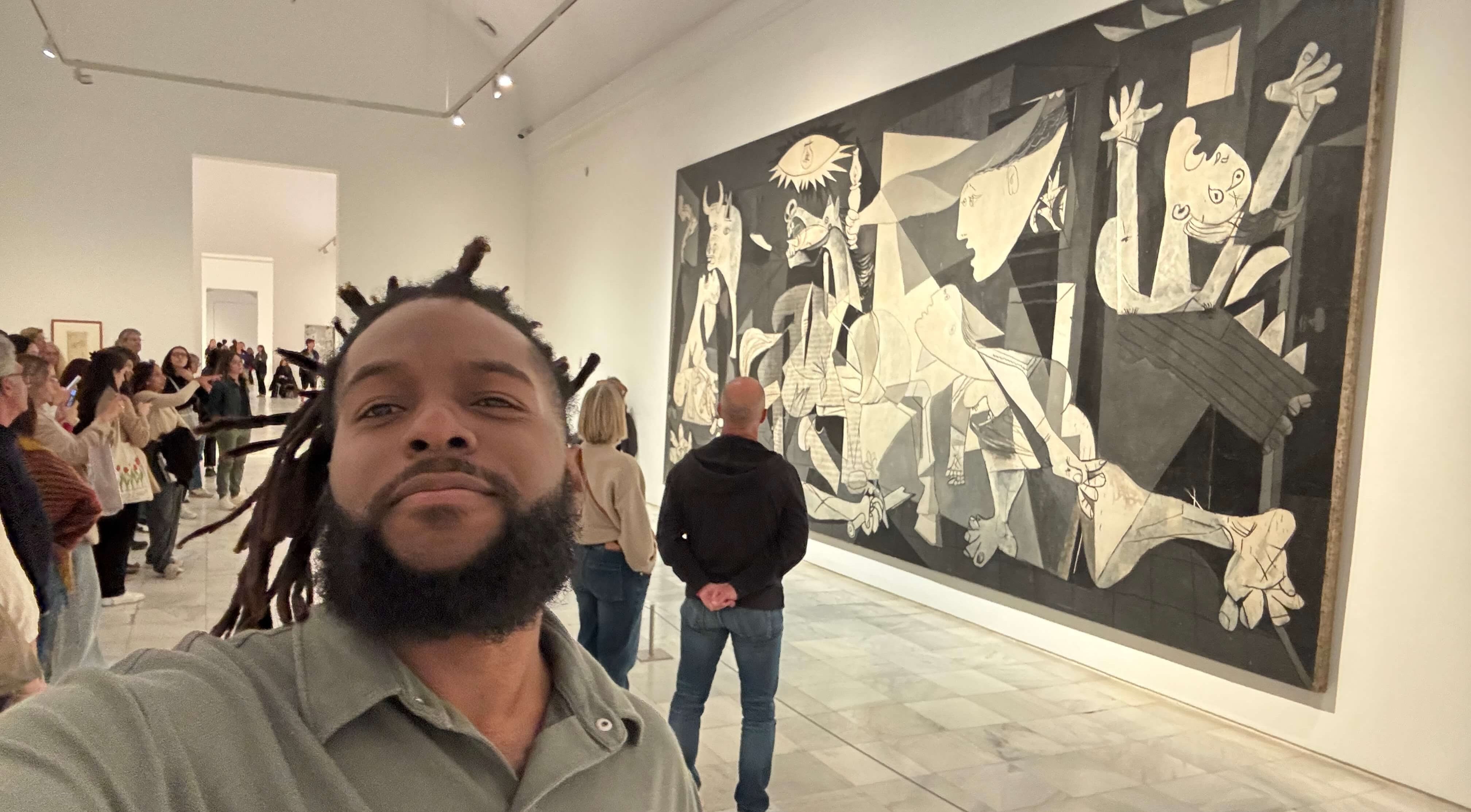
I stood there for a while just taking it all in. The abstract figures. The exaggerated expressions. All the chaos. Something made so long ago still made the room feel so alive.
But what impacted me the most actually wasn’t the painting.
It was what I found on the back wall…
A series of photographs of the piece as it was being created. From its earliest sketches to its final form.
And what struck me was how ordinary some of those early stages looked.
Yet there they were. Hanging in one of the world’s greatest museums.
On one wall was a masterpiece…
On the other wall were photos proving it wasn’t always a masterpiece.
And somewhere between those two walls I stood physically and metaphorically.
You see, I’ve been building a lot of things lately.
A YouTube channel. A newsletter. A community for creative people around the world.
And sometimes I catch myself looking at what exists today and feeling disappointed that it doesn’t resemble what I see in my imagination yet.
And I start questioning myself as I stand between where I am and where I hope to be.
If you’ve felt something similar, here’s what I learned in the presence of Picasso’s greatness….
If I’d seen Picasso’s earliest sketches without knowing what they would become, would I have recognized their potential?
Honestly, probably not.
The finished painting gave those sketches a meaning they didn’t possess on their own.
And that’s one of the key advantages we have when studying the lives of great creators.
We get to see their beginnings through the eyes of someone who already knows their endings.
But unfortunately we don’t have that luxury with our own work.
We have to make things without knowing what they’ll become.
We have to believe in possibilities we can’t even see yet.
And sometimes, we have to continue creating while standing in front of something that looks nothing like what we imagined.
But here’s the thing about the creative process that I wish I knew a long time ago.
The version we imagine is never the version we actually create.
Those photographs on the back wall didn’t simply show Picasso adding more and more paint until the painting was finished.
They showed him changing his mind. Moving things around. Removing things.
Trying something, seeing what it revealed, and making another decision.
And that’s the purpose of every step of the creative process.
Instead of being a smaller version of the vision in our head, it’s meant to reveal what that vision needs.
A sketch isn’t a failed painting.
It’s a way of discovering a painting.
A rough draft isn’t a failed book.
It’s a way of discovering what the book is trying to say.
An early creative project is never a failed vision.
It’s a conversation with what vision needs from us to be brought to life.
And so this changes the relationship we have to our unfinished work.
Instead of asking, “Is this as good as I imagined?”
Now ask, “What has this taught me that I couldn’t have known before I made it?”
Because progress lives in that creative dance between what’s made and the Maker.
In the quality of the decisions we are becoming capable of making.
The sentence we remove.
The scene we realize doesn’t belong.
The audience we understand a little better.
The idea we finally know how to express.
Sometimes progress looks like adding something.
Sometimes it looks like starting over.
And sometimes it looks like realizing that the thing you’ve been trying so hard to make isn’t the thing you actually want to make at all.
Your masterpiece is hidden in the potential unraveled during the creative process.
The work doesn’t just become clearer as we create.
We become clearer through creating it.
Stay creative,
Way Walker
P.S. If this sparked something for you, you can buy me a coffee here.